Monday, August 6, 2012

Harold and the Purple Crayon

Another favorite book at The Speech House is Harold and the Purple Crayon by Crockett Johnson.  I admit that I only discovered this book series about 4 years ago.  Harold is a young boy who draws everything with his purple crayon.  As he draws his pictures, he interacts with them: walking down the purple sidewalk, into the purple forest, and riding in the purple hot air balloon. The stories are cute, humorous, and imaginative.  Harold draws a dragon to guard the apples on his tree but his own drawing scares him and his shaking hand draws an ocean. 

The thing I like the most about this book is its use in working on creativity, imagination, pretend, and problem solving.  These are goals I often work on with students having ASD.

Activities:
  • Discuss the idea of pretend and imagination. Some kids may have trouble with the idea of Harold interacting with his drawings.  This can also spark a discussion of "daydreaming" as a creative and enjoyable process.
  • Harold usually encounters problems on his adventures.  Before turning the page, have the student give multiple ideas on what Harold could do Rolls of butcher paper work well for this activity so that the child can draw out their complete adventure, roll it up, take it home, and practice retelling the story.  For older kids or to take this to a smaller scale, I have used adding machine rolls of paper.
  • Cooperative activity: Group works by taking turns adding to the picture story.
  • Art Activities: Purple paint (make your own purples with red & blue), shades of purple in cut out shapes, purple yarn art...
  • Sensory: Grape koolaide for painting or in playdoh. Shaving cream play with food coloring to combine colors.
  • Printables: Finish the story, Coloring page, or simply photocopy images from the book.  A good following directions activity is coloring according to verbal directives, "Color the moon yellow".  Make it a verbal expressive task by having the child give you coloring directions. 
  • Snacks: blueberries, grapes, PB&J, purple fruit chews/roll-ups, jello, purple cow (milk and grape juice drink)...
  • Game:  There is a commercially produced game but it may be hard to find.  It consists of a whiteboard and purple marker and a set of story cards.  The kids pick cards and have to draw the element on the board creating a story to go along with it.  The next child picks another card to add the board and adds to the story. I like to have the kids repeat the story from the beginning each time they add to it; this works on story telling, sequencing, and memory skills, not to mention creativity and flexibility to accept and add to others ideas. (Ebay is often a good place to find older games).
  • Movie on Youtube:

Other Links:
Enchantment Theater Guide to Harold: This site has a study guide to go along with their theatrical performance.  It has some nice resources about theater and some good question and review worksheets.
Purple Theme:  Lots of fun activities around the color of Purple.
Purple Books & Printouts at Enchanted Learning
Delightful Learning blog of activities she did with her kids using this book.
Pamela's Bookclub has activities a fun Mad Lib activity.
HBO Family online Harold draw, stamp, paint activity.
Speech Lady Liz has some fun ideas for Speech Therapy activities. Be sure to click on her yellow links to find some great materials she created and shared to go with her activities. 
Muhlenberg edu pdf booklet for ages 7 & up; for ages 7 & under.

Tuesday, July 17, 2012

Asperger Perfectionism (sigh)

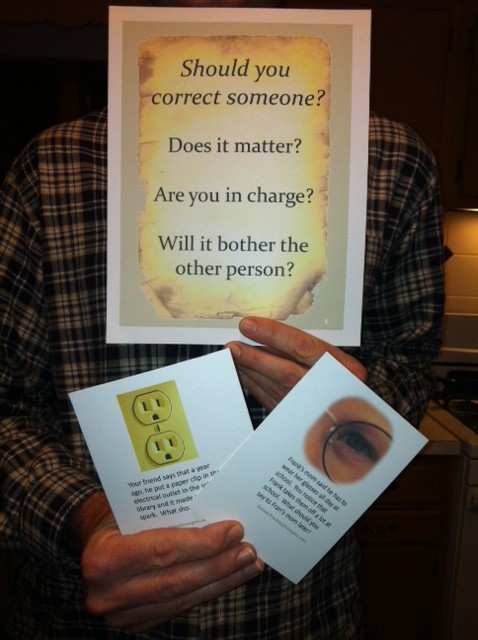
A trait that we often see in our kiddos who have Asperger's, High Functioning Autism, or Obsessive Compulsive Disorder is the need to control everything going on around them.  You know the kids I am talking about.  Here a few examples of things they might do...
  • The teacher (you) or other student is reading a book and mispronounces a word, skips a word, or doesn't pause long enough at a punctuation mark (or whatever the child is currently being instructed to do at school).  This child will blurt out with authority, "You skipped a word..."
  • Another child does something such as getting out of his seat, talking out, etc.  This child is the self appointed 'rules police'.  He will immediately call attention to the faux pas. (But he usually misses his own behavior lapses and will argue to the death about why he was not in the wrong - in his own mind he would never break a rule so he likely has some legitimate 'rationalization' to excuse such an unthinkable indiscretion).
  • The assignment is to quickly sketch a picture of ....  This is the child who continually erases his picture, asks for a new sheet of paper so he can start over, or takes 3X as long to finish because he has to insert every minutia of detail into his 'quick sketch'.
  • Unfortunately this can also be the child who is so overwhelmed at a task, because in his mind making it perfectly requires herculean effort, that he will often quit before he even tries to begin.
As I typed that last example, I recognized a bit of myself in that one... does anyone else reading this have some of these traits of perfectionist?  Of course we all share some traits with our kids on the spectrum.  We and they are both cut from the same human cloth.  The difference between neurotypicals and those with ASD is the degree to which these traits affect their lives.  We can recognize the problems in ourselves, most of the time, and then we can exert self-control, employ self-talk, put the issue back into the proper perspective, and go forward to do what needs to be done. Individuals with ASD have a much more difficult time navigating this process.

How do we deal with this issue? 

I have not conquered this at all but I will list some of the tools and resources I have employed or am planning on employing to help the children I see with the issue of perfectionism.

Social Thinking Curriculum:  There are many pieces of this curriculum that are ideal in helping the child understand how constantly correcting others is perceived or received:
  • Unexpected Behaviors: It is unexpected behavior to correct the teacher or parent over minor issues. It is also unexpected behavior to correct classmates; that is the teacher's job, not your job.
  • Problem Scale:  How big of a problem is it that the teacher skipped a word?  If it is a #1 or #2 sized problem then you do not need to call attention to it, just ignore it because it does not really make any difference to the outcome.  If the omission will result in a bigger problem (i.e. doing the wrong homework, etc.) then it is okay to point it out in the correct way.
  • Thinking of Others: This is a perspective-taking task. How would you feel if someone pointed out every small mistake you made?  Would it make you feel sad or angry or embarrassed?  Then it probably does the same thing to others.  It also interrupts the lesson or distracts others. 
  • Social Behavior Map: Construct this map to show the sequence of consequences and the negative outcome of constantly correcting versus the more positive outcome of overlooking minor mistakes.
Children's Books:


Beautiful OOPS! is a book about turning mistakes into positives.  A small tear, a drop of paint, a crumple all become an interesting part of the creation.         

The Girl Who Never Made Mistakes: Beatrice never makes mistakes...never ever... until one day when she makes a very public mistake and learns that mistakes are okay.
  
Amelia Bedelia Books:  Amelia constantly makesmistakes but in the end everyone laughs and still loves her!

A Bad Case of Tattle Tongue: Picture book about tattling and the negative aspects associated with this behavior.  Again, picture books serve as excellent pre-packaged social stories.  A social story typically only describes the desired outcomes.  Whereas a picture book usually adds a moral or lesson learned.

Visual Supports & Social Stories:


Other Resources & Links:

This is a great tool to help learn to gauge size of emotional responses.  It works along with the problem scale.  Rate size of problem then rate size of reaction or emotion.  Try to teach children that making a small mistake is a #1 or less size problem and we need to learn to overlook those things. 
Autism Teaching Strategies by Joel Shaul:http://autismteachingstrategies.com/autism-strategies/flexibility-rigidity-cards-and-panels-downloads-page/ Cards to print and cut out for teaching about being more flexible.  Though these cards deal more with being rigid in routines, they address the core problem of being inflexible in thoughts, ideas, and activities.  This website has many great resources for those who work with individuals with ASD.
 Joel Shaul Resources 
Another resource by Joel Shaul: Correcting others and tattling too much: Social skills activities to teach kids with autism who have these problems

Friday, July 6, 2012

Cool Ali

Cool Ali, by Nancy Poydar,  is a story set in the city in the heat of the summer.  A girl who loves to draw goes outside to escape the heat in her apartment building.  There she begins to draw with her chalk on the sidewalk. She draws pictures that serve to distract the attention of all the neighbors from the heat of the day.  As she draws scenes of cooler seasons, everyone suddenly feels refreshed. 

It is a cute and clever story well suited to our current hot summer.  This book is fun for all of my speech therapy clients.  Here are some of my therapy ideas for this book:


Articulation:  Pull targets from the story and create carrier phrases. 
/k/ initial - Cool
/l/ medial - Ali
/l/ initial - "likes to draw"
/r/ blend - draw
"ch" - chalk
Any sound can be addressed as you and the client "draw" your own "chalk" (crayon, marker, map pencils) targets on cards or paper.  It would also be a fun activity to go outside and make chalk drawings on the sidewalk, if it is not too hot. Here in East Texas it is usually too hot.

Language & Processing: 
  • Sentence Structure:  N-V-Obj: Ali draws an umbrella; cut apart sentences either word by word or in chunks (for lower functioning children) and have them reorganize the sentences.  For higher functioning clients, throw in some sentences that can be reordered in two ways; this way you can work out their mental flexibility skills as well.
  • Verb tense: Ali is drawing... / Ali drew / Ali will draw / Ali has drawn; for younger clients you may only pick one tense to work on or the tense they have as a target; for the older kids you could have them work on changing sentences to reflect all of the tenses.
  • Pronouns: She is drawing... Can also work on referent pronoun understanding: Ali drew an umbrella.  She colored it yellow and white. She=Ali / it= umbrella
  • synonyms: hot, heat, sweltering; see how many words you can generate to replace a target word or ways to reword a sentence to convey the same idea.
  • antonyms: hot / cold; Ali draws cool pics in the summer heat but she draws sunny pictures while it is raining.  This could lead to an "opposite day"...
  • Predictions:  What will she draw?  How will it make the person fell? What do you think the person will do?
  • Reasoning: Why did they feel cooler?  Were they really cooler? Were they pretending? Did they feel better in some way after Ali drew her pictures? Why/How?
  • Figurative Language: mop their brow, chilled to the bone...
One of the applications that I really like about this book involves helping children with ASD or abstract reasoning problems process the ideas in the story.  It requires them to think beyond the surface structure of the pictures and words to realize that the "coolness" the people are feeling is a state of mind contrary to the reality of the heat.  Also, at the end of the story it begins to rain and Ali's wonderful pictures are washed away.  This event can serve as a model for helping the ASD child to process change and disappointment without becoming emotionally upset. At first Ali appears concerned about her drawings but then she enjoys the rainbow of colors streaming down the pavement and contentedly takes up her drawing on paper in her apartment while the rain cools off the heat of the summer; now she draws sunny pictures.

I have found several nice resources online:

The Teacher's Guide lists lots of online games, links, printouts to address vocabulary, matching, spelling, word searches, etc.

Harcourt for Second Grade Teachers  scroll down until you find Cool Ali


Julian Beever's 3-D Chalk Art - Truly amazing art that will "blow your mind".  Great for discussing perspective and illusion (helping kids to understand things are not always what they seem).  What is real in each picture?  How does the artist make the pics look 3-D? What are the people doing that add to the realism in the drawings?...


Great video that shows the artist at work creating his 3-D chalk art.

This video shows the ways spectators interact with the drawing after it is completed.

Extension activities to chalk art:  3-Dimensions, perspective in drawing.

Other extensions to the story itself:  temperature, weather, drawing.

Tuesday, June 26, 2012

An Alternative Approach to Teaching Sound-Symbol Correspondence

Over the years I have worked with a number of children with cognitive challenges.  Learning their ABCs is a difficult task and learning the sound associations for the letters can be even  more difficult.  In addition to working with this population I was also simultaneously working with children who had Apraxia, a motor speech disorder, and children with various delays or disorders in speech production.  I observed that almost all of the children, even some of the ones with Apraxia could imitate environmental sounds such as animal noises, car sounds, etc. I had been using a purchased product called Easy Does It for Apraxia.  In this program each speech sound is assigned an environmental sound in order to help the pre-literate child learn their target sound. ("K" is the dinosaur sound since dinosaurs were so large that they crashed "k-k-k" when they walked).  This is not a novel idea since Speech Pathologists have always used this method (I learned it 30 years ago as an undergraduate).   But since I was working with this specific program I adopted most of the sounds they used (even though some of them were less than ideal).  This is when I realized I had at least three clients in my caseload with varying degrees of cognitive impairments and all of their mothers were asking me about literacy skills for their children. All of these children had already spent several years in school trying to learn by traditional methods.  These methods were not working for them.  Most schools use the correspondence of the intial sound of a word to teach the phonic sound of the alphabet: A-apple, B-banana...  As an SLP working with speech sounds, I understood how difficult it can be for some neurotypical children to understand word and sound segmentation and that children with cognitive impairments would also struggle with this task. 

The SLP neurons started firing and I tried to devise another method for my clients.  Most of these clients were able to learn the basic sound symbol associations using this devised strategy.  Those with milder impairments eventually understood enough of the basic skills and then went on into learning literacy skills by more traditional methods.  The children with greater cognitive issues all learned the sound symbol correspondences but did not really go on to be literate.  However, they did learn enough to be able to use prediction settings on various devices since they could identify initial sounds and basic vowels in order to key in word portions.  In this way they did develop rudimentary phonics skills.  I understand that most cognitively impaired children are taught primarily by sight word methods, however I still feel there is a benefit to having some basic phonics skills.

My disclaimer in presenting this idea here is:  Always attempt traditional methods for literacy development, but if those methods fail over time, this is an alternative method that could be tried to teach the basic skills.  This method is to serve as a bridge to understanding sound-symbol correspondence and then pick up more traditional methods when possible.  One more important note:  The limited time in speech therapy sessions is not adequate for learning this, copies of all must be sent home with the parent to work with their child at home.

Step 1:  Learn to say the alphabet:  I first observed that most of these children learn to say the alphabet (or sing it).  So the first step I undertook was to teach them one to one correspondence and to touch each letter of the alphabet as they slowly sang the song. 
                                                
Step 2: Learn to order the alphabet: Once they demonstrated this skill, we worked on laying out the alphabet in order. First I traced ABC cut outs and made an alphabet line to match letters. For lower cognitive clients, I broke the line into groups of 5-6 letters for practice. Clients did not have to master ordering before we worked on sound symbol correspondence.

Step 3: Sound symbol correspondence: This skill does not have to be addressed in any specific order. If the child was working on speech sounds, I chose those targets first since the children were already familiar with the corresponding environmental sounds (e.g. /l/ singing sound, /s/ snake sound... Although I used a lot of the sounds from the program, I substituted some with sounds I felt more appropriate or easier to be identified). Most of the time I presented the sounds in alphabetical order since it was easier to keep track of the presentations. Depending on the cognitive skills of the client I presented groups of letters and sounds 2-5 at a time. We played with toys that correspond to the sounds (/s/ rubber snakes which we slithered around the room while saying "s-s-s-s:).  The short vowel sounds were introduced initially since most traditional methods do this and since those are encountered first in the phonemic awareness step. I also made letters for several sounds that incorporated the symbol in some way: either the sound was pictured on the letter or the letter was morphed into the object associated with the sound. As we played the sounds games, we matched the items to the letters. Most of the children learned them fairly quickly.
 

Step 4:  Practice with the sound symbol correspondence:  We then played a variety of games such as returning to the ABC sequencing activity and placing the letters on the alphabet line when their sound was produced by the therapist or placing the corresponding sound card (singing face) on the letter (L).  Once the child was proficient in the sound symbol correspondence we launched into phonemic awareness.

Step 5: Phonemic Awareness - Sounds in words:  At this point I had a magnetic board with magnetic squares of the alphabet.  I wrote the alphabet on the board with a Sharpie and arranged the letters in alphabetic order (So that they could return the letters to their proper places in the sequence, making them easier to locate when needed and to further reinforce alphabetical order).  We then began working on c-v and v-c combinations (real and nonsense words).  I would say /æ/ ("a") and the child would place the A, then /t/ and the child would place the T.  Then we would run our finger smoothly under the word to blend the letters into "at".  I worked on blending immediately to avoid the child segmenting the sounds during production. (It always drives me crazy when a child has not learned to blend sounds smoothly.)    Once two sound combinations were mastered we proceeded to c-v-c words: "h-a-t".  I worked in word families to increase success: at, hat, bat, cat, mat,... 

Step 6:  Phonemic Awareness - Initial sound changes in words:  Once that skill was mastered we worked on word changes.  At first I only worked on intitial sound changes.  "Spell the word "at"; add a sound to make it say "hat"; change "hat" to "bat"."  Word changes required some help initially with lots of verbal cues (added emphasis, reps of initial sounds...) but once they understood to listen to the first sound and segment it back out of the word then replace it with another letter they were hearing, they were able to be independent. 

Step 7:  Phonemic Awareness - Final sound changes:  Same as above but at the end of the words.  Once again they learned that sound changes can occur at beginning and ends of words. Then I would mix up the two positions: "Make the word 'in'. Now make it say 'pin'. Change 'pin' to 'pit'. Change 'pit' to 'hit'."

Step 8:  Phonemic Awareness - Medial sound/vowel changes:  Now they understoond that any sound in the word could change and their ears were able to listen and hear what those sounds were.  We then mixed it up and played with changes everywhere in the word:  Spell "hat"; change it to "bat"; now "cat", now "cap", "tap", "top" "tip".....

Step 9: Phonemic Awareness - Blends:  ccvc words (plot), ccv words (try), cvcc (desk), etc.

Step 10:  Hooked on Phonics:  At this point the child is ready for more traditional methods and the program I had on hand was the Hooked on Phonics program.  This program pulled in diphthongs, sight words, and other spellings.

The only part of this program that is really different is the method of learning the sound-symbol correspondences.  I admit I have only used it a handful of times but I was surprised how children that I did not think could learn this skill were able to do so.

Phonemic awareness methods are invaluable for all children in their literacy skills and I have used them often in therapy.  I especially spend time teaching this with my clients who have both significant speech disorders and language impairments because these children are at risk for literacy problems also.  These skills fit well with practicing our articulation, phonology, and auditory processing skills. 

Friday, June 8, 2012

The Phantom Tollbooth


The Phantom Tollbooth is a fun book to use with older kids.  I typically pull this out for a middle school to high school aged student with language difficulties.  This book is chock full of vocabulary and figurative language.  It can be quite humorous.  It also usually requires a good deal of discussion and explanation for the language disordered student to grasp many of the ideas. 

The main character, Milo, a very bored little boy,goes on a journey via a magic tollbooth.  He encounters a number of strange characters in the Lands Beyond.  He returns from the journey a very imaginative boy.


When working with a long book I generally do the following:
  • Take turns reading aloud.  I will read and have the client follow along.  This allows him to see the words, hear the proper pronunciations, and improve his own reading fluency skills.  When it is his turn to read, he can practice words he has heard and I can assess his reading mechanic skills, helping him sound out or figure out difficult words.
  • Pick out new vocabulary.  As we encounter words that may be unfamiliar, we can discuss what they mean.  I also like to work on learning to interpret contex clues by pointing out clues to the meaning already in the passage.  We can then discuss synonyms that are more familiar to the client.
  • Sometimes we create vocabulary cards.
  • I will find or create supporting worksheets that target specific areas the student is needing to address such as chapter questions, vocabulary reviews, plot diagrams, character analysis, etc.
  • At the end of each chapter, the student must summarize what occurred in the chapter.  This serves the purpose of working on written expression skills and providing a quick synopsis that we can use to review the events each week and at the end of the book.  The student can also take these summaries and use them to write a review of the entire story.
Some good objectives for this book:
  1. Vocabulary Development: lots of new words to look up, define, or use with context clues.
  2. Figurative Language: lots of terms to examine such as "time flies".
  3. Multiple meaning words, homonyms, heteronyms such as "whether man"
  4. Synonyms in dictionopolis
  5. (I will add more as I progress through the book with a current client... it's been awhile since the last time I used this book).
Here is a list of mined resources on the web:

Figurative Language Chart and Answer key
     *  Flashcards vocabulary
     * Idioms

Tuesday, May 29, 2012

Pete the Cat: I Love My White Shoes


Link to my Facebook page where I have posted links to activities and resources related to this fun children's book, Pete the Cate I Love My White Shoes. 

This is a cute and simple book that can be used with preschoolers.  There are two prominent goals I have pulled from this book:
1. Teaching colors and associations of colors to specific    
     objects.
2. Teaching children not to get upset about little problems.

So tomorrow in the preschool group we will read this book in circle time.  There is an audio cd with my book that plays the song or the song can be downloaded from the Harper Collins link.  Youtube video.

The boys have come a long with sitting in circle time.  Participation is another issue but I hope such a fun song will get them singing along and perhaps stomping their feet as we sing.  I have found loads of games and printables online as well (see links).

During circle time we will use the flannel board cutouts to keep the little ones engaged.  The cutouts are a set of colored shoes to add at the appropriate times during the reading of the story (matching the items that Pete the Cat steps in changing the color of his shoes).  Then we will sing the song.

While still in circle time, we will introduce the concept of seasons and will discuss what Pete might wear on his feet each season: Winter = Warm Boots / Spring = Rain Boots / Summer = Sandals / Fall = Sneakers.

We will break to Art time where we will assemble a mini book of the story and color the shoes on each page the color associated with the items in the picture (strawberries = red).  This will exercise their association of colors to constant objects and their matching and naming skills.  The children can take this mini book home in order to practice the story with parents and reinforce the concepts as well as just having fun reading time.

Play time will include a game of "pin the shoe on Pete". 

Links to these games and more can be found here (look in the comments boxes for specific links).

I have discovered some other Pete books that I plan on adding to my library:

6-6-12 Update

We repeated this book today with the pre-k group.  Our most reluctant child readily engaged in dancing and singing the song.  It was a success.

Today's art activity involved using pre-cut blue construction paper shapes to assemble into Pete the Cat and glue onto a yellow sheet of paper.  Of course, they then chose the color shoes they wanted for their Pete the cat.  The project required:
  • 1 large oval = Pete's body
  • 1 medium circle = head
  • 2 small triangles = ears
  • 4 small rectangles = legs
  • 1 long curled piece = tail
  • 4 shoes

Rocking in My School Shoes:  Youtube Reading

Four Groovy Buttons:  Youtube preview clip

Tuesday, May 15, 2012

Quick as a Cricket by Audrey Wood

In Audrey Wood's book Quick as a Cricket, a boy uses similes comparing himself to a variety of animals.  This is a fun book well suited for working on similes, word associations, opposites, adjectives, and figurative language.  Each animal is paired with a descriptive word: Quick as a cricket, busy as a bee, gentle as a lamb.  Nicely enough, many of these are also common idioms or figures of speech.  Here is a list of the adjectives and the animals in the book:
Small / large                               Sad / happy                         Nice / mean
Cold / hot                                   Weak / strong                      Loud / quiet
Tough / gentle                             Brave / shy                         Wild / tame
Lazy / busy                                 Quick / slow

Lizard / bee / monkey / poodle / tiger / lamb / shrimp / rhino / clam / lion / buffalo
cat / fox / frog / shark / bunny / lark / basset / whale / ant / cricket / snail

Watch a Youtube video of this book.

Activities: 
1.  Read through the book discussing the vocabulary as needed. Classify types of animals: pets, wild, tame, ocean, bugs, etc.  (It is always fun to print photos for sorting.  I will try to upload my boardmaker pages that go with this story later.)
2.  Print the printables found at this link to kidzclub.com.  Discuss which adjective goes with each animal and why.  This will help the student begin to understand word associations and how to interpret figurative language.
3.  Brainstorm other animals or adjectives that might go together and why.
4.  Act out some of the words: Dramatic play / experiential learning.
5.  Cut out the word boxes found in the printable link at kidsclub.com and match opposites.
6.  Think of new associations: "What could we say about a snake? A porcupine?..." or "What other animal is quick?"
7.  Have the students make up a book that illustrates some of their own qualities.


More Resources: